A passion for nature

Tag: Scottish wildlife Page 1 of 3

Gannet

The hectic life of the gannet

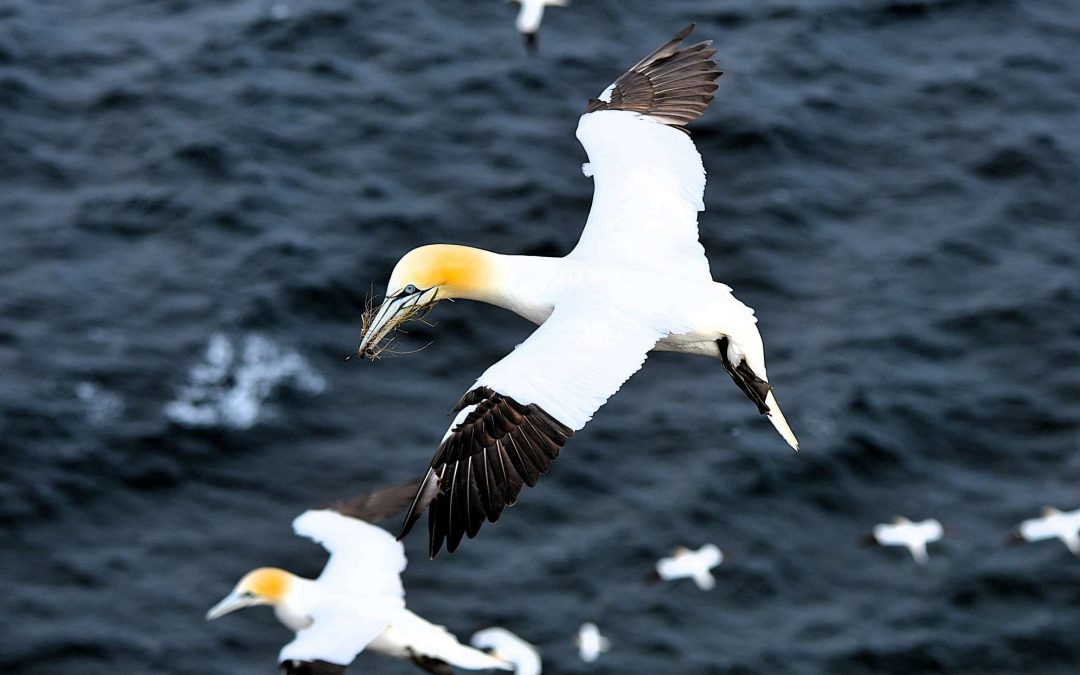
As I approached the clifftop at Troup Head in north Aberdeenshire, the intoxicating aroma of briny sea air suddenly enveloped my senses and ahead of me the white-cloaked forms of gannets swirled in the air on outstretched wings.

With excited anticipation, I increased my pace and was soon standing on this spectacular clifftop near Gardenstown looking down upon throngs of gannets, their buff-yellow heads and striking, snow-pure plumage glowing bright in the morning sunshine. There was a stiff breeze and many gannets rode the air currents, hanging motionless for several seconds before wheeling away down towards the sea.

This was a bustling hive of activity and a cacophony of cackling noise – a seabird city that inspires and enthrals.  The large, white-fluffed bodies of rapidly growing chicks nestled besides their parents, while adult birds squabbled amongst themselves. There were many adult pairs without chicks, and they bobbed and swivelled their heads to strengthen their pair bonds in the hope of successful breeding some stage in the future.  This is a feature of gannets, with young adults congregating at nesting sites yet still not ready breed. However, they gain vital experience by attending these breeding colonies where they learn the ropes of courtship and establishing themselves into pairs.

Troup Head is the only mainland colony of gannets in Scotland and the cliffs have an interesting history with the birds only first breeding there in the mid-1980s. Over the following years, numbers increased rapidly, and at the last official count in 2023, 4,379 pairs were recorded. Gannet numbers are now increasing again after being temporarily hit hard by Avian Flu.

Many other seabirds breed at Troup Head, including guillemots and razorbills. It was especially gratifying to see good numbers of young, almost fully fledged, kittiwakes on many of the cliff ledges. These elegant, oceanic gulls have endured much in recent times, both from the Avian Flu and a shortage of their main food, sandeels, most probably caused by our warming seas.

After a while enjoying the gannets, I headed eastwards along a path, passing coastal features with such enchanting names as Nether Stair and Hare’s Nose and then down into Downie Bay where wildflowers swayed in the sea breeze, including perennial sow thistle and autumn hawkbit. Several yellowhammers swept up in the air before me, the males displaying wonderful lemon-hued heads, whilst the plumage of the female and young birds was more muted, yet still with an underlying beauty.

I also heard the jangling call of a corn bunting, which resembles the sound of a bunch of keys being vigorously shaken.  They are scarce birds nationally, with numbers having plummeted over the last half century or so due to the intensification of agriculture. The bird called once more and I glimpsed it on a distant fence post by a field of oats. As I was about to bring it under the scrutiny of my binoculars, it whirled away on brown-blurred wings and disappeared into the depths of the cereal crop where its nest was no doubt hidden.


Red kite

The return of the red kite

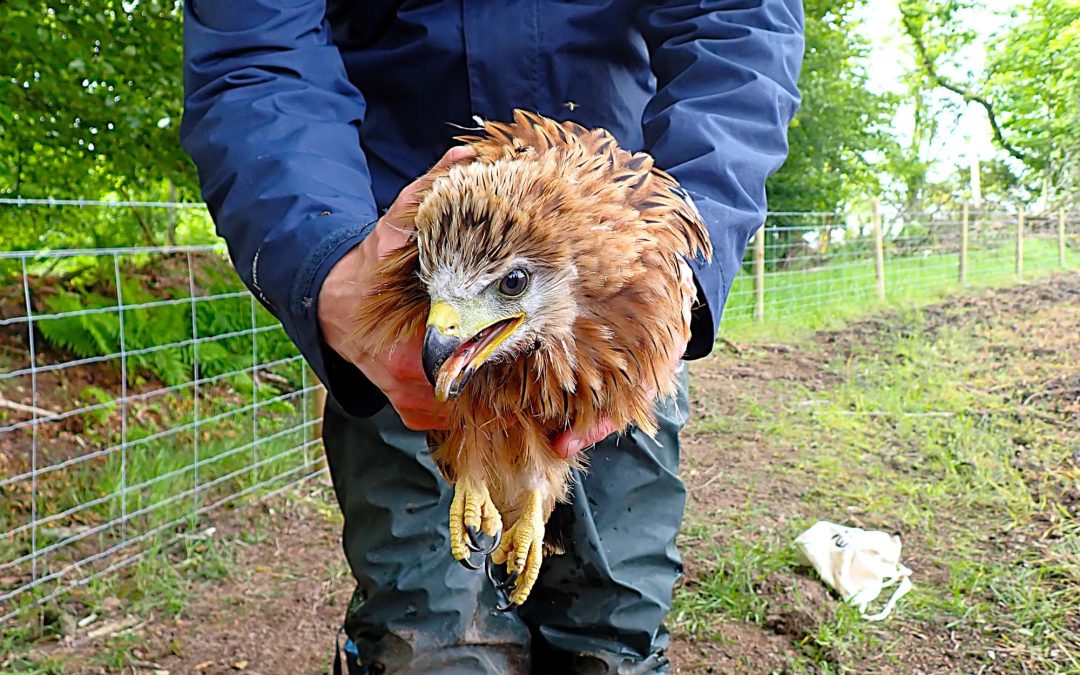
The piercing grey eyes of this young red kite drew me irresistibly into their wild depths, reflecting the rolling fields and woodlands that lie in the shadow of the Braes of Doune.

This was a bird of unparalleled beauty, elegant lines and russet feathers, and remarkably placid too, which is the nature of young red kites when getting ringed. A short while earlier, an expert tree climber had lowered this kite and her sister in a protective bag from its nest to the ground, where they were both carefully leg-ringed and then returned to their nest near the kite viewing centre at Argaty  in central Scotland.

Ringing young kites plays a vital part in their conservation, enabling their movements to be studied once they have fledged so that we can learn more about their biology, as well as helping detect any cases of illegal persecution such as poisoning.   

The ringing team was led by Duncan Orr-Ewing, Head of Species & Land Management at RSPB Scotland, who has been involved in over-seeing  the reintroduction of red kites to Scotland since the early 1990s.  In what must rank as one of the greatest conservation success stories of modern times, a bird on the brink of extinction in the UK has bounced back big style due to a series of innovative reintroduction schemes using young birds from continental Europe.

These reintroductions began in 1989 at the Black Isle near Inverness and the Chilterns in England, followed in subsequent years by further releases at several other locations, including central Scotland, Dumfries & Galloway and Aberdeenshire.

At one time, red kites were our commonest bird of prey and their typical gliding flight gave rise to the old name for the bird of glead or gled – derivations of which can still be seen in Scottish place names today such as Gladhouse and Gledhill. However, they were relentlessly persecuted, and in Glen Garry estate alone, 275 red kites were slaughtered as ‘vermin’ between 1837 and 1840. By the end of the 19th century, the gled had been almost completely exterminated from Scotland.

In the early 1900s, there were just five pairs of British kites hanging on for grim survival in the central valleys of Wales – today, thanks to the reintroductions, there are about 6,000 breeding pairs in Britain, representing around 17 per cent of the world population.

Duncan says: “The methods we have developed are now being used as a template model by other European countries instigating their own reintroduction schemes, and this is something we should be proud about it.”

Some of the first young kites reintroduced into the UK came from Spain, and now in an ironic twist, such has been the extent of the British recovery, young birds from England are being used to bolster the Spanish population following a recent decline in numbers in the Iberian peninsula.

The kite, it would seem, is back for good in the British Isles and in the process has become a standard bearer of what can be achieved in nature revival if there is the will and determination to do so.

Enchanted by the frog chorus

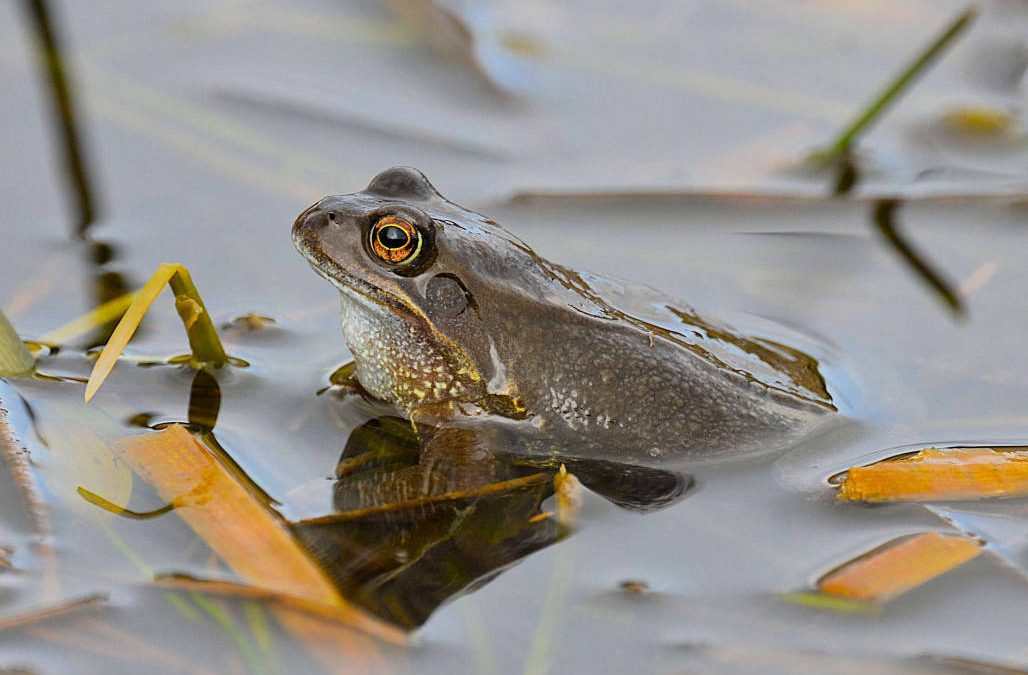
I heard the frogs before seeing them – a pulsating, rhythmic hum that ebbed and flowed across the afternoon air. This frog chorus was hypnotic and alluring, and accompanying their gentle croaks were the rougher ‘qwark-qwark’ calls of mating toads.

I was on the approach to a remote hill pond near my home, which I had only discovered a few months previously during deepest winter. At the time, I reckoned the pond looked the perfect place for spawning amphibians and now it transpired that my hunch had proved correct.

Not wanting to spook the frogs and toads, I crawled slowly towards the pond edge, a few short pulls of the arms and legs, then a short pause, followed by a few more. When close to the pond, some of the frogs and toads cavorting on the water surface spotted me and in a sudden swirl were gone. Non-plussed, I bided my time and soon their heads popped up and the air filled once more with their resonant calls.

This was heavenly paradise, nature in the act of procreation and the water continually rippled as the males vied for females, sometimes clambering on top of their backs and gripping tightly in the mating embrace known as amplexus.

Strangely, I had never previously seen frogs and toads together at the same time when mating. Normally, frogs spawn in early March with toads following a few weeks later. However, this was the earliest in the year I had ever seen toads active on a breeding pond, which in turn had resulted in the overlap with the frog spawning and was possibly a worrying sign of climate change.

In another bizarre twist, on some occasions male toads crawled onto the backs of female frogs as if to mate with them. A case of mistaken identity no doubt, but I did briefly ponder the seemingly implausible notion that frogs and toads might have the potential to interbreed and hybridise. It is an occurrence I have never heard of before and quickly dismissed it from my mind.

As I watched the amorous amphibians, a pair of grey wagtails alighted on the far side of the pond, and darted around snapping up tiny flies, before spiralling away again in an undulating flight.

After an hour or so, it was time to go, but on slowly turning my body,  I came face to face with a writhing ball of toads on the grass behind. A poor female toad had attracted the attention of two males, both of whom gripped tightly onto her back.  She slowly crawled along the ground with her unwelcome cargo – a ponderous and energy-sapping process. Would she be able to shed one of the males by the time she reached the pond, or would she have to endure both for several days to come?

With such pressures, it is hardly surprising that many toads succumb at this time of year – it may be the season of renewal, but the dark cloud of death is forever present.

The wild aura of the Insh Marshes

By Keith Broomfield

The flat expanse of the Insh Marshes swept away in the distance, glowing ochre under the soft autumnal light.

From my vantage point on a slope in Lynachlaggan wood, my mind visualised the intricate mosaic of pools scattered across this rich, natural bogland that covers 10 square kilometres of the River Spey floodplain between Kingussie and Kincraig. This swampy paradise is home to breeding curlew, lapwing, redshank and snipe, and the whole area acts as a giant natural sponge, holding water and allowing it to slowly drain back into the River Spey.

At this time of year, it is an important haunt for wintering whooper swans, wigeon and tufted duck, while hen harriers can sometimes be glimpsed quartering over the ground in search of prey.  Dusk was settling, and I scanned my binoculars across the landscape in the hope of spotting a harrier coming in to roost, but this vast marshland lay tantalisingly empty.

No matter, for only a short while before in the wood at Lynachlaggan I had watched a great-spotted woodpecker on a lichen covered alder probe eagerly for invertebrates, moving up the trunk in short, jerky bounds. This bird was meticulous in its search for creatures hiding under the bark, examining each section of the trunk closely with scrutinising eyes, before moving up to the next. Once it had reached the top of the alder, it took to the air in an undulating flight to alight on a nearby birch to begin the process all over again.

The autumnal dankness of the air had an earthy aroma, a natural perfume of moss, decaying wood and peaty soil that aroused the senses in a way that only nature can. Normally we perceive nature by sight, sound and touch, but its redolence is equally compelling and is deliciously addictive.

The walk at Lynachlaggan is a delightful relatively short circular trail, and my course was frequently interrupted as I stopped to examine the profusion of fungi scattered on the ground. There were brown birch boletes and red-capped fly agarics, and on a decomposing tumbled tree trunk a cluster of sulphur tuft toadstools glimmered like a beckoning beam of light. Fungi are one of the bedrocks of the natural world – they are recyclers, nutrient providers for plants and underpin every type of habitat there is. Many have developed mutually beneficial relationships with trees and without fungi our woodlands would be much impoverished.

Then, another burning incandescence shone from the edge of the trail. It was a small huddle of scarlet waxcaps, their umbrella caps burnished and beautifully polished. The gills on the undersides where soft and yielding to the touch, the scarlet colour of each toadstool complementing the dark-green of the mosses all around.

The hen harriers out on the marsh may have proved elusive, but the woodpecker and the fungi had provided ample compensation – and the lack of harriers provided the perfect excuse to return to Lynachlaggan on another day in the hope of spotting one settling in to roost in the dwindling gloaming light.


Ptarmigan

In search of the ptarmigan

By Keith Broomfield

It was like searching for a needle in a haystack –  instinct told me that ptarmigan were watching my every move on this 3,000ft high boulder field in the mountains by Glenshee, but their cryptic plumage had merged these subarctic grouse seamlessly into the stark lunar landscape.

Their droppings lay scattered around the summit of Carn Bhinnein and it almost seemed as if the birds were taunting me by their near presence. Camouflage is their means of survival and despite my frustration at being unable to find any ptarmigan, a begrudging admiration swept my mind at their ability to maintain perennial concealment.

After much fruitless searching, I abandoned the quest and instead focused on a cushion-like ball of hairy fluff nestled in among the rocks. It was woolly fringe-moss, a high mountain specialist with the most appropriate demeanour of appearing to have fleece-like insulation to protect itself from the cold mountain air.

It is a common moss of uplands, especially open, stony, windswept ridges and plateaux, and features intricate wispy twists and curls. Nearby lay another high montane specialist – fir clubmoss – which is more closely related to ferns than mosses. The rocks around me were encrusted with colourful lichens, and it felt like I had been drawn into a mysterious primeval world, surrounded by nature’s earliest creations.

I hunkered down in a gully out of the cool wind to ponder ptarmigan.  They are mountain chameleons, their  plumage changing with the seasons, merging and matching in sympathy with the surroundings. In winter, ptarmigan turn almost completely white, but the spring and summer plumage is more of a mottled grey and brown, with flashes of white. The feet are completely feathered, which not only prevents heat loss, but acts as a useful pair of snowshoes in winter.

Ptarmigan eat the leaves and shoots of arctic-alpine plants, as well as insects in the summer. The crowberry is important and ptarmigan feast upon their glossy black fruits in late summer.

Rising to my feet, I wandered further over the boulder field – five more minutes looking for ptarmigan, then I would call it a day. The five minutes stretched to 10, and then to 15, but the ptarmigan remained elusive, so I descended back down into a nearby glen. Late-season meadow pipits and skylarks bounded up in the air before me and a kestrel hovered above on quivering wings.

By a craggy knoll where a lone sentinel rowan stood, the mewing calls of a family of buzzards whirled across the breeze. It was a somewhat monotonous call, more akin to a seagull than a bird of prey. Soon, I spotted two of the buzzards, tumbling upwards on widespread wings before they swept away over a shallow-curved ridge.

I looked back up the glen towards the distant conical top of Carn Bhinnein from which I just descended, and wondered whether the ptarmigan were still watching me from their lofty vantage points in among the high boulder fields – invisible and inscrutable to the very last.

Grasses – delivering the air we breathe and the food we eat

By Keith Broomfield

The names roll deliciously off the tongue – fescues, bents, and Yorkshire fog – and which represent among our most ecologically important organisms of them all – the grasses.

Grass is so ubiquitous that we tend to take it for granted as an integral part of the landscape. And there is a truism there, for grasses are the environment,  found in abundance from the equator to the poles and prospering everywhere we look. They are the core foodstuff for a huge variety of creatures – and, of course, the foundation stone of our agriculture, whether to provide grazing for livestock or grain for our daily bread. Without grasses, nature and humanity are nothing, an empty vassal devoid of hope or meaning.

Bizarrely, perhaps, grasses are seldom remarked upon in nature writing, probably because they lack the powerful and impactful blooms of wildflowers. But grasses are as beautiful as any flower, and as I wandered recently through an ungrazed hill pasture near my home, huge sweeps of the delightfully named Yorkshire fog grass swayed in the breeze like a rippling sea.

Although not always immediately obvious to the eye, grasses do have simplified, wind-pollinated flowers that turn into seed heads as the season progresses. In Yorkshire fog, the flowers are tinged with pink and which often deepen into a deeper pinkish-purple before fading, and when they do so, will transform a pasture into a wonderful pallid hue.

On walking across the pasture, I endeavoured to identify as many species of grass as I could, and it became completely addictive, for the more I looked, the more was revealed, and it was impossible not to become smitten by their sublime beauty. One particularly eye-catching species was wavy hairgrass, with incredibly delicate, shimmering and almost translucent spikes. Other engaging species were red fescue, sweet vernal grass, common bent and silver hairgrass, each type exhibiting finesse and elegance in their shape and form.

I sat on a small, mossy mound surrounded by various grasses to reflect and immerse myself in their green and wonderful world of proliferate abundance. A small cricket crawled over one grass blade before disappearing into the thick and green tangled microworld where beetles scurried and lacewings rested.  A ringlet butterfly on dark-flashed wings twirled up into the air before quickly settling again.

Field voles would abound in this grassy area, and in the sky above, kestrels and buzzards often soar in anticipation of pouncing upon one. Grass is a fundamental building block of nature, underpinning so much other life.

Grasslands and have been described as Britain’s largest solar panel, absorbing sunlight and in the process taking-in carbon dioxide and converting it to oxygen. They deliver the air we breathe and the food we eat, and provide habitats that support a diverse array of life.  I sat for a while longer in this grassy margin, transfixed by a polka-dotted ladybird that had magically appeared, and which slowly climbed a frond of grass, before unfurling its wings and spiriting itself away into the warm summer updraft.


Paradise in a nutshell at Knoydart

By Keith Broomfield

They were flowers of the sea breeze, a sweeping carpet of yellow-dazzled colt’s-foot that swept along the wild Knoydart foreshore in a shimmering celebration of the beauty of a west highland spring.

Often described as Scotland’s last wilderness, Knoydart is completely addictive, comprising an eclectic mix of wild rugged mountains offset by tranquil meadows in the glens, and beautifully benign woodlands where wildflowers shine from every corner.

It was the woodland wildflowers by the small settlement of Inverie that really caught the eye as my wife, Lynda, and I wandered along a waymarked trail signposted as ‘Knoydart in a Knutshell’.  The bright, limey-green freshness of tree leaves unfurled gloriously from overhanging branches, set against the backdrop of the sweet cascading music of willow warblers and the abrupt nightingale like song-bursts of blackcaps. On the ground, the gold-spangled blooms of lesser celandine glowed, primroses flickered in jaune splendour, and the first bluebells were tentatively unveiling themselves.

Perhaps the walk should be renamed as paradise in a nutshell, for this was a place where one could linger for eternity to revel in the soothing balm of nature. One of the plants on the woodland floor that drew my interest was wood sorrel, which has the habit of growing on moss-covered tree stumps and fallen branches. It has an under-stated, subtle beauty and it really is worth examining this flower closely, for what at first glance appear as white petals are in fact gently inscribed with lilac.

Soon, we reached the Inverie River, with its unusually crystal-clear water where trout and salmon thrive. A pair of sandpipers flew by the bank edges on quivering wings, the male trilling his love song as he doughtily pursued his mate in an elaborate courtship display. Sandpipers are all too brief breeding migrants to our shores, arriving in mid-April and most having departed by early August.

A short distance further on and we reached the shore at Inverie Bay where the swathes of colt’s-foot became the star attraction. Colt’s-foot, which look a bit like dandelions, thrive on shallow, well-drained soils such as here on the Knoydart foreshore, and are often found by gravelly track edges throughout the highlands. It is one of our earliest emerging spring flowers, and the plant is so-called because of their large horseshoe shaped leaves that develop after the flowers have wilted. The trait of flowering before the leaves emerge has given rise to the folk-name ‘son-before-father’.

The tide had receded, and out on the muddy pools of the bay a whimbrel probed its long, curved bill into the sediment for worms. Similar in appearance to a small curlew, this whimbrel was passing through, heading north to breeding grounds in Shetland or beyond. An oystercatcher ‘kleeped’ in the distance and the flute-like hypnotic resonance of a calling cuckoo floated across the air. Superlatives hardly give justice to the true magic of spring in Knoydart, for this is a place that fills the heart with an overwhelming contentment spirited from the portals of heaven.   

Otter

A magical otter encounter

A piercing whistle whirls across the damp air from the far bank of the River Devon. I know it is an otter but as I peer through a tangle of alder and willow branches, I see no movement. Another whistle, even louder this time, and then I spot the otter running along a carpet of golden, tumbled leaves by the bank edge.

The otter slips into the water and swims upriver leaving a V-trail in its wake, continually calling all the while – a whistle with a pitch of such intensity that there was an air of desperation to its tone. This might have been a mother looking for a lost cub, or perhaps a male seeking out a mate, but whatever the case, the animal did not seem unduly perturbed by my near presence, despite eyeballing me several times.

Indeed, after swimming a hundred yards upriver, the otter then turned around and swam straight back down again, passing close by me before disappearing in among a twisted mass of alder roots by the bankside. The whistling had stopped, the otter was gone, and the only sound permeating the air was the gurgle of rushing water – beautiful and hypnotic music drawn from the very depths of the river.

Normally, dawn and dusk are the best times to see river otters, but this encounter was in the early afternoon, which underlines that when it comes to wildlife spotting, always expect the unexpected.

I wandered on, disturbing a diminutive wren that churred its annoyance as it swept up on brown-blurred wings from a thick stand of twisted bramble stems. Wrens are one of our most ubiquitous birds, equally at home by a riverbank or on high windswept moors, or in thick gorse by the coast. The name ‘wren’ derives from the middle English ‘wrenne’, meaning ‘little tail’.

Another whistle permeated from across the water, but rather than an otter, it was a kingfisher streaking just above the river’s surface in a bolt of electric-blue. It has been a good year for kingfishers on the river, the low rainfall in the early part of the breeding season suiting their requirements perfectly for seeking out minnows in the languid pools.

Down by my feet, a scrap of black velvet caught my eye. It was a dead water shrew, the black upperparts contrasting starkly with the white belly and chest. It is the largest of our shrews, a capable swimmer that can dive to depths of two metres in search of aquatic invertebrates.

Finding the corpse reminded me when as a boy I had found a dead water shrew by a burn that tumbled into Loch Earn, and as I cradled its velvety body in my hands, I wished it were possible one day to glimpse a live one. Since then, I have seen a living water shrew on only two occasions – but that is enough for my dream to have come true, providing a fleeting insight into their mysterious and secretive lives.


Glorious chatter of redwings in the gloaming

By Keith Broomfield

As the diminishing light of dusk gathered over the hill pasture in the strath, redwings swept up from the green-spiked rushes ahead of me, dancing and bobbing in the air before alighting on the top of a beech that stood proud in a nearby shelterbelt.

The air hung heavy with the redolence of autumn, and because the claggy soil was frost-free and yielding, the redwings had been foraging in among the rushes for worms and other invertebrates. These delightful winter-visiting thrushes were lively birds, perennially wary of my presence, and constantly uttering high-pitch ‘chook’ calls to keep in contact with one another.

When hard frosts descend, redwings switch from invertebrate food to avidly seek out the berries of hawthorns and hollies, quickly stripping them bare of their rich bounty. It is at this time they will often come into gardens. If the weather remains bitter and prolonged, redwings may move further south and west to seek respite in milder climes.

Redwings breed in Scandinavia and adjacent areas of northern Europe, descending upon our shores every autumn. A small number also breed in northern Scotland and I recall once finding a nesting pair near Lochinver in Sutherland.

The proximity of this sloping pasture to my home makes it one of my favoured haunts at dusk – a compelling environs where roe deer graze and buzzards soar in search of field voles and small rabbits. Indeed, as I continued my circuit of the field under the background chatter of the redwings, rabbits abounded everywhere, their white-fluffed tails glowing like beacons in the blur of the gloaming.

Despite their abundance, the future of this rabbit colony hung in the balance because myxomatosis or the highly contagious rabbit viral haemorrhagic disease could wreak devastating havoc at any time. However, rabbits numbers have been high here for several years and so far they have avoided disease.

The previous week I had glimpsed a stoat on the hunt for rabbits, its sleek, sinuous body undulating in harmony with every contour of the ground. I lost it in among a thick flush of rushes, but I imagine it would find plenty of rich pickings on this hill pasture.

Frances Pitt, the early 20th century naturalist, reflected upon the fear that stoats instil in rabbits. She wrote: “A rabbit that knows a stoat is on its tail becomes so silly with terror that it sits down and waits its doom” … although she countered this by continuing …. “yet I have seen rabbits feeding unperturbed with a stoat romping near”.

My stoat sighting was unusual, for it was the only one I had encountered over many years of walking these fields. This made me ponder – why so few stoats when there is much easy prey in the form of rabbits about?

I don’t know the answer,  underlining that there are many insidious forces at work in our environment – many human induced –  which we comprehend little about, and that is something I find deeply worrying.

A close encounter with a marine leviathan

By Keith Broomfield

A large, mushroom-shaped creature pulsed into view through the briny underwater haze like a mysterious alien from another world. I slowed my breathing through my snorkel tube and watched it glide past, awed by its size and intricate frilled tentacles that trailed behind the bulbous main body.

It was a barrel jellyfish and the first time I had encountered one under water, although I had glimpsed them several times before in Scottish seas from piers and when aboard boats. These cream-coloured monsters really can grow to the size of a barrel, but they are gentle giants, feeding on plankton and their sting is mild and not generally harmful to humans. The biggest specimens can exceed 1.5m in length and 35kg in weight.

I was snorkelling at Ardmair Bay, a sheltered backwater of Loch Broom that lies close to Ullapool in Wester Ross. It is one of my favourite snorkel haunts because of the clarity of the water and the abundance of marine life. As well as the barrel jellyfish, there were scores of lion’s mane jellyfish drifting about, which I carefully steered around because their multitude of long trailing tentacles do give a nasty sting.

I was snorkelling in a sheltered part of the bay, which was home to a host of specialised creatures that prefer a more benign marine environment, including fluted sea squirts, dahlia anemones and burrowing anemones. The white coloured sea squirts were especially abundant, growing in clusters upon seaweeds. Sea squirts have sac-like bodies with two siphons on the top (one inhalant and the other exhalant) through which they draw water and carefully filter out food particles.

A glowing nugget of orange caught my eye on the seabed about 15ft down. I took three deep breaths and dived under to investigate and was rewarded with the remarkable sight of a type of sponge known as a sea orange. It was a fascinating organism – about the size of a cricket ball and with several large pores on the body. Sponges are the simplest of all marine animals, and like the sea squirts, gain nourishment by filtering water through their bodies.

After surfacing and regaining my breath, I drifted over a forest of kelp, and was immediately drawn into the embrace of another bizarre lifeform known as sea mat, which coated fronds of kelp in a dazzling, white crystalline veneer.  While sea mats are superficially similar to the encrusting lichens found on rocks on land, they instead belong to a mystical group of colonial animals known as bryozoans. I lifted gently a frond of kelp to examine the coating of sea mats in more detail, enthralled by their intricate, embroidered shawl patterning.

I ventured back into deeper water and in a truly special moment, a harbour seal swirled past me, before taking a wide circle to inspect this strange humanoid that had encroached upon its watery world. Unsure whether I was friend or foe, the seal flashed away into the blue depths, sparking a tingling wave of exhilaration to course through my body.

Page 1 of 3

Powered by WordPress & Theme by Anders Norén