A passion for nature

Author: keithbroomfield Page 6 of 7

Ghoulish screams of the night

It is like something out of a horror movie, a long drawn out scream that breaks the still January air. It is so sudden and so ghoulish that it’s enough to send shivers down the spine; a shriek that spins the mind into hallucinatory overdrive. What kind of hideous creature is out there in the dark void?

And there it goes again. It is almost as if someone is being strangled, a piercing scream with a husky hoarseness towards it faltering end. But this is no beast or brutal murder scene, it is fox mating season and in vulpine-speak this is a vixen saying to a dog fox, ‘come and get me, I’m ready to mate’.

Dog foxes also scream and have a range of other vocalisations, making this an incredibly noisy time in the fox calendar as the males and females communicate with each other. The vixen is only receptive to mate for a few days each year and there is no room for error; miss the copulating opportunity, then there will be another year to wait.

The actual nitty-gritty of the mating process can be rather unedifying too with the dog fox and vixen sometimes becoming inadvertently ‘locked’ together for an hour or more – an unfortunate mishappening that can result in even more screaming.

But with most vixens pregnant by early February, the night air soon falls silent again; a new generation of foxes is on its way. Indeed, with the new year upon us, there are new generations of all kinds of creatures on their way.

The lifecyles of many of our insects and other invertebrates are particularly intriguing because at the moment there no adults around at all; the next generation simply consisting of eggs or larvae biding their time and only emerging as adults once the weather begins to warm.

But some insects delay this larval stage until well into winter. On a recent mild December evening I set my live moth trap in the garden to see what flying creatures could be lured towards its glowing attractant light. When I checked the trap the following morning there were two mottled umber moths inside.

They are rather attractive early winter-flying moths, with buff coloured wings gently inscribed with dark lines and varying shades of brown. It is only the males that fly – the spider-like female moths are wingless. After hatching from her cocoon in the ground, the female will crawl onto a tree trunk or branch where she will waft a heady cocktail of pheromones in the hope of attracting a passing male to mate with.

She will then lay her eggs in a tree crevice and soon all the adults will have perished, the next generation consisting of eggs that will hatch into caterpillars in the spring. In late March and April, these little caterpillars will be like gold dust for small song birds such as blue tits, which will feed avidly upon them just as their own nesting season is getting underway.

The diversity of seaweeds on our shores

The mass of tangled kelp along the strandline of this East Neuk beach was at least a foot deep in places, a mix of yellow-brown flattened fronds and thick tubular stalks.

At the base of each stem were intricate stubby tendrils that would have attached the seaweed to rocks just below the low tide mark. Normally these would provide tenacious grip, but such has been the ferocity of recent storms that the kelp had been plucked with ease from their holdfasts by the crashing waves and surging currents.

I was at Cambo Sands by Kingsbarns, a few miles south-east of St Andrews, and the prolific amount of washed-up kelp along the beach was testament to the sheer power of the ocean – and also the resilience of our coastal wildlife. Seaweeds such as kelp are incredibly important for a wide range of marine life, creating shelter and safe places to forage.

When snorkelling on the Scottish west coast I constantly marvel at the abundance of goldsinny, corkwing and rock cook wrasse found in these kelp forests. Juvenile coley and pollack also thrive within their thick embrace, as do colourful two-spotted gobies.

Seaweeds are algae and a vast array of species typically occurs in the intertidal area. Each type tends to be especially adapted for a particular zone on the seashore and to differing degrees of exposure to the air or inundation by the tide. It is the stuff of biology class at school; channel wrack is found on the upper part of the shore, bladder wrack in the middle zone and serrated wrack on the lower shore.

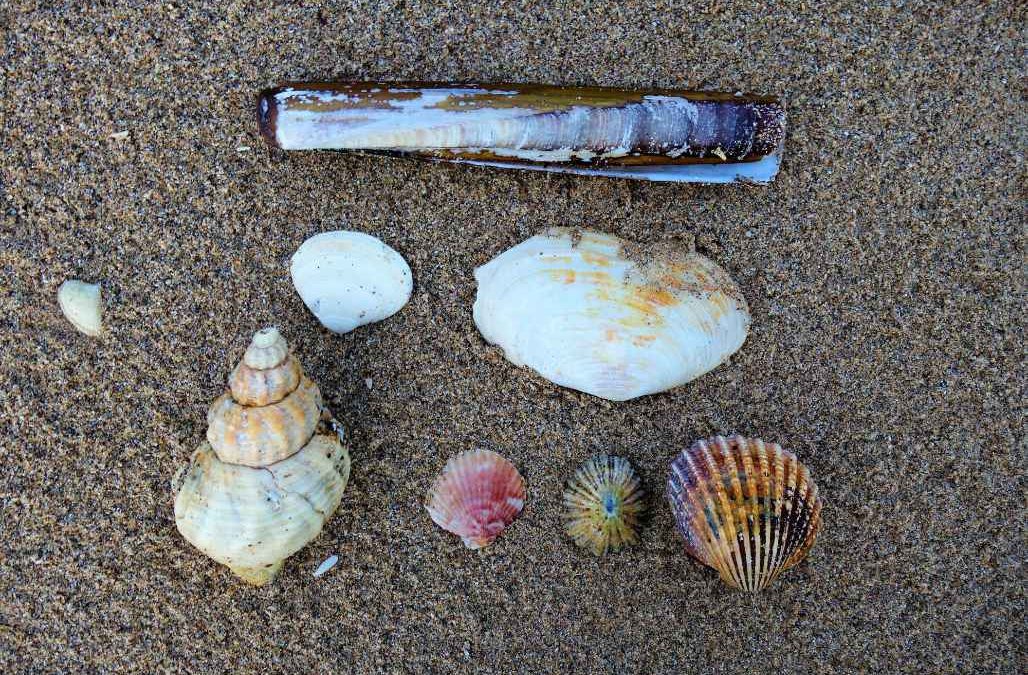
The remains of many molluscs had been washed up on this beach too – in particular surf clams, their attractive half-shells littering the sand. Ranging from cream to rusty brown in colour, they display a series of concentric lines that match the gentle semi-circular curve of the smooth leading edge of the shell. Surf clams, or trough shells as they are often known, live buried in the sand on the lower shore and poke their short siphons just above the seabed to filter food from the plankton-rich water.

An occupational hazard for these clams is having their siphons nibbled off by flatfish such as flounders and dabs. But all is not lost, for the damaged tip is able to regenerate.

In a large shallow pool on the lower edge of the shore, a few wigeon dabbled in the shallows. They are delightful little ducks that love to feed on eelgrass. Eelgrass might look a bit like seaweed but it is actually a most unusual flowering plant that can handle being submerged by seawater.

But this part of the coast looked too exposed for eelgrass and these wigeon were almost certainly feeding on something else – but what, I was unable to tell.

The strange world of lichens

On one of my regular walking routes there is a patch of forest where the pine trees are heavily adorned with silvery grey lichens that hang from the branches like feathery tufts.

It is a most compelling place, especially on winter mornings when the atmosphere is damp and the trees shrouded in mist. The aura here is almost primeval; silent air and patterns of grey. I’m not sure why this part of the wood should have so many lichens when nearby areas do not. But the reason doesn’t really matter, for the ambience they create is addictive and I suspect delivers an unconscious draw that makes this one of my favourite walks

Lichens are a bit like moss, all around us yet seldom remarked upon. They are also one of our more fascinating lifeforms, for they actually consist of two (or more) organisms rather than one. It’s a concept I find difficult to get my head around, but in simple explanatory terms lichens are partnerships between algae and fungi. But they are so closely interwoven with each other that they appear as one.

It is a mutually beneficial relationship where the alga produces food through photosynthesis while the fungus uses its inherent properties to create structure and support, as well provide mineral nutrients and store water so as to prevent desiccation.

So, although the numerous types of lichens are classed as individual species, they are technically a combination of species. Lichens are incredibly successful and survive in some of the most inhospitable places on earth. Climb to the top of the Cairngorms and there will be colourful lichens on the rocks. You’ll find them too on boulders by the seashore where some are tolerant of salt spray and even brief immersion in saltwater.

Indeed, once your mind-set moves into lichen mode, you start seeing them everywhere. Any decent-sized rock will hold lichens, as will stone walls and trees. They even occur on garden lawns. Their variety is immense and they come in a multitude of different forms, some just as creeping encrustings on a rock (often in colourful oranges and yellows), and others with fluffy tendrils like the ones in my wood. There are around 1,800 different types of lichen in the British Isles.

An intriguing one is the aptly named map lichen, a low-spreading lichen found on rocks by the coast and which does indeed look like a map with its black squiggly lines set against a green background.

Lichens are important ecologically, offering shelter for a host of tiny invertebrates such as insects, spiders and molluscs, which in turn provide food for small birds like treecreepers and tits. Research has shown that woodlands abundant in lichens hold a greater diversity of wildlife than those where they are scarce. Birds often use lichens as a source of material to make their nests.

Lichens are also excellent indicators of clean and unpolluted air – and for that reason alone it is always satisfying to discover them thriving in your home area.

Autumn down by the river

The floor of the small strip of woodland behind our house is thick with fallen leaves, a multi-coloured carpet that rustles and gives gently under the heavy pad of my footsteps.

I scoop my hands into an accumulation of leaves by the side of the path and already I can see that the process of decomposition has begun. In time, this little handful will transform into leaf mould that will return valuable nutrients back to the soil. And as I place the claggy clump back onto the ground I notice a couple of tiny millipedes wriggling on my fingers, another indication of the importance of fallen leaves, this time as shelter for invertebrates.

When the heavy frosts come, this leaf litter will act as an insulating blanket providing a haven for micro-creatures that may otherwise succumb if exposed to the full winter cold. Blackbirds will forage in such areas, turning over the leaves with quick flicks of the beak in search of the hidden bounty that lies below.

Jays have been busy collecting and hoarding beech mast and acorns from the woodlands around my home patch in Strathdevon. They can fly quite large distances in this quest, for on several occasions I’ve seen these wonderfully coloured birds flying across from one side of the strath to the other. Often their throats appear engorged, full of nuts ready to be buried and stored. This autumn’s nut harvest will then be retrieved at a later date when food is scarce.

Down by the river a new fish pass was created a few years ago to aid the passage of salmon to their spawning grounds further upstream. It certainly looks a lot easier to negotiate than the previous stepped concrete structure, which was rather narrow and didn’t seem to allow enough space for the fish to gain momentum as they ascended the falls.

I’ve noticed when fly-fishing on the river this year that young salmon, or parr, have been relatively scarce, a possible sign that the fish are not doing well at the moment. Hopefully, this new salmon pass will increase the chances of successful spawning. I’ve already seen one fish negotiate the weir, a flapping well-coloured grilse of three or four pounds in weight.

It is interesting to watch herons on the river at this time of year. They like to hang around by the shallow pebbly rapids as they know that migrating trout heading upstream will be at their most vulnerable in such places. I wonder if the herons intuitively hunt in these parts of the river, or do they learn from experience and by watching other herons?

Bird Club book sale

From this Saturday (1 September) and throughout the month of September, visitors to the headquarters of the Scottish Ornithologists’ Club (SOC) in Aberlady can take advantage of 50% off all second hand books.

The collection ranges from bird identification guides for the UK and overseas, handbooks of particular species or bird group, studies of bird behaviour and migration, and a host of other natural history publications. Collectable items include a selection of New Naturalist and Poyser titles in very good condition.

The Club’s history as a book trader stretches back to 1961 when it started selling new ornithological titles from the SOC’s original headquarters in Regent Terrace, Edinburgh. At that time, it was almost certainly the only specialist bird bookshop in Europe and probably the world. George Waterston (one of the founders of the SOC) and his wife, Irene, were the driving force at that time as they had built up so many contacts around the world. Eventually, whilst still at Regent Terrace, the Club sold all the new book stock and goodwill to St Anne’s Books as the organisation couldn’t afford to finance the required holding of stock and by then there were many other specialist bird book dealers. It was many years later that second hand books were sold in any quantity and the Club’s re-location to Aberlady can really be considered the start.

The majority of the books in the SOC shop are duplicates from the SOC’s extensive library (also housed at Aberlady). Any donations and bequests are used to augment or fill any gaps in the library first, with any duplicates or titles outwith the scope of the collection put out for general sale in the shop.

Susan Horne, SOC Librarian explained the reason for the sale: ‘As with many high street retailers these days, it is increasingly difficult to compete with online retailers. Where we are situated is very picturesque but there isn’t the level of footfall to keep up with the generous donations of books that we receive from our members and the general public. We really value these donations but we also have limited storage space. We hope that by having a big sale like this, the benefits will be many-fold: We’ll shift some stock, raise some funds and create a bit of a buzz among local natural history enthusiasts; there’s already some excitement among Club members who are keen to get along to the sale and pick up a bargain!

“At the end of the day, all money from sales of the books goes directly to the charity so it’s a win-win situation; the SOC has an educational remit so the more bird literature there is out in the community, the better. It’s not all about raising funds; raising awareness is equally important”.

The sale runs from Saturday 1st to Sunday 30th September, open daily 10am-4pm, Waterston House, Aberlady.

In tribute to the blackbird

It is late afternoon and I’m sitting on a garden chair soaking up the August sun; its bright warmth a soothing tonic that relaxes the very soul.

I sit so still that a male blackbird alights on the lawn only a few feet away and looks at me quizzically with a cocked head. He is unsure whether I pose a threat or not and flickers his wings nervously, uttering a couple of “tchook, tchooks”, the precursor to his full-blown alarm call.

But he soon settles and begins to forage on the mown grass, moving in a series quick hops, before pausing to examine the ground. Through such methodical searching, he begins to snap up an impressive number of worms and other small creatures; the eye so keen that the slightest hint of movement is detected, no matter how miniscule.

The rich pickings clearly make my garden lawn a good place for this blackbird to be. Indeed, the blackbird is one of those birds that thrive best in the presence of humankind and among our dwellings. If one was to create the blackbird version of utopia, then the final outcome would not be too far away from the patchwork of lawns, parks, bushes and trees found in suburbia.

Lawns are great places to find invertebrates because blackbirds are not hampered by long grass when foraging. Ornamental and native garden bushes offer safe nesting sites and provide berries in autumn to feast upon. In deep winter when the soil is frosted hard, blackbirds take advantage of windfall apples on the ground and food on garden bird tables.

It is a two-way benefit and it would be almost unthinkable to imagine our gardens without blackbirds because they bring so much, especially in spring and early summer when at dawn and dusk the melodic song of the handsome cock bird rings out all around.

The poet William Henley was certainly full of praise for the musical elegance of the blackbird’s song when he wrote: “The nightingale has a lyre of gold/The lark’s is a clarion call/And the blackbird plays but a boxwood flute/But I love him best of all”.

A real dazzler of a moth

It was the white that stopped me in my tracks, not a shiny brilliant white but more a shimmering paleness that shone out from the grass and heather of this Perthshire moor.

At first I thought it may have been a flower but when I crouched down closer I realised it was a magpie moth; a real dazzler of an insect with a beauty to rival any butterfly. The pattern was quite dramatic – symmetrically arranged splashes of black and orange beautifully offset by its pallid wings.

It’s a shame that butterflies get all the plaudits when moths and so many other types of insect are as equally striking. And even those that are not top of the beauty league are no less fascinating for it. I admire these underdogs of the animal kingdom and make a point of seeking out such creatures whenever I can.

Magpie moths often occur on hill and moor but they are found in gardens too where their caterpillars are a pest on currant bushes. Birds tend to avoid them as they are toxic to eat and the caterpillar advertises this fact through its bold warning coloration.

As I examined the moth, I was aware of the continual and rather monotonous mewing seagull-like cries of a family of buzzards from a nearby forestry plantation. But in amongst the buzzard noise, I could hear a higher pitched chattering.

It was a kestrel family, a mother and two fledged youngsters working their way along the forest edge and passing right beneath the soaring buzzards. The young kestrels were incredibly noisy; right little livewires who were finding life so very exciting and which contrasted starkly with the mournful mews of the buzzards.

From being common 30 or 40 years ago, kestrels are now much less so. Conversely, buzzards have had a remarkable turnaround in fortunes and are currently our most abundant bird of prey having soared in numbers in recent decades.

I reckon there is a connection here in that the buzzard has displaced the kestrel by out-competing it for food. Rising populations of goshawks and peregrine falcons may also be adding to this pressure through direct predation, whereas in the past kestrels had a free rein and limited competition. So maybe there is a bit of a natural reset going on here.

But then again, things are seldom black and white in nature and most likely there are other factors at work too. The most obvious one is habitat loss, in particular areas of rough grassland, which has resulted in fewer voles and mice being around for kestrels to prey upon.

As I watched the kestrels disappear over the rim of a small hill, I wondered what the future holds for these wonderful little falcons. They are up against so many complex environmental challenges and I can’t see them returning to their former abundance any time soon.

Slow Worm

Slow worms can move pretty fast!

Okay, so I know this is a totally weird thing to say, but if there is one thing guaranteed to excite me when out for a country walk, it is finding a sheet of corrugated iron lying on the ground.

It is like coming upon a treasure trove, for the chances are there will be fascinating creatures sheltering beneath. The corrugations mean there is space for animals to move and the metal absorbs heat and forms a wonderful waterproof roof. What small beast wouldn’t find this a comfortable and cosy place to be?

Such thoughts were firmly on my mind when I stumbled upon such a sheet of metal by the bankside of a tumbling river. Field voles are perhaps the commonest find under such places, but I had high hopes for slow worms, one of our most unusual and rarely seen creatures.

With anticipation mounting, I firmly gripped a corner of the corrugated iron. One, two, three and up it went, and there they were, two coppery coloured slow worms. If ever there was a misnomer then this is it, for they are neither worms nor particularly slow.

Slow worms can move pretty fast if the inclination takes them. One of them did disappear rather quickly, but the other hung around long enough for me to take a few photographs. I have only ever seen slow worms on a handful of occasions in my life, mostly from lifting corrugated iron or plywood sheets.

I suspect slow worms are more common than we realise, but are seldom seen because they spend most of the day hidden under rocks or in crevices, only coming out at night to feed upon small invertebrates, especially when it is mild and wet.

While they look like snakes, slow worms are in fact legless lizards. Unlike snakes, they have eyelids and can blink. Slow worms can also shed the end of their tail like a lizard, a handy defence mechanism if seized by a predator.

Indeed, one of the slow worms under this piece of corrugated iron was tail-less. Perhaps a buzzard or fox had pounced upon it in the recent past, or the loss may have been the result of fighting with another slow worm. Males often squabble and square up to each other.

There was also a toad under the corrugated iron and a bustling ant nest. These were black garden ants and were engaged in frenetic activity, running this way and that, some carrying their larvae or pupae to safety after being so rudely disturbed. Worker ants feed the developing larvae in the nest on sugars and liquefied insects.

One of nature’s great sights is watching these ants swarm in summer, when the winged males and females suddenly erupt from the nest and take to the sky and mate, darkening the air like a swirling plume of black smoke.

In search of the blaeberry bumblebee

I’ve been trying to photograph blaeberry bumblebees but have not been having much luck as they are rather shy creatures that tend to buzz away just as I’m about to press the shutter button of my camera.

Indeed, it is somewhat fortuitous that no-one has stumbled upon my endeavours in the hills above Dunning in southern Perthshire, as it is not unusual for the odd expletive to let rip as yet another bee does a disappearing act. Ah, such is the calming effect of nature!

I’ve become a bit obsessed with blaeberry bumblebees in recent weeks, for I find them most attractive insects with their distinctive orange-furred abdomens and busy behaviour. They are rather small bees and seem particularly attracted to the yellow flowers of bird’s-foot trefoil, which grows in profusion by tracksides in this part of the eastern Ochils.

These delightful wee bees are so-named because while they’ll feed on a variety of wildflowers, they do prefer areas where there is at least some blaeberry around. As such, they tend to be rather scarce and localised in distribution, but in suitable habitat can range up to mountain tops over 3,000ft high.

Unlike honey bees that have nests holding many thousands of workers, the nest of the blaeberry bumblebee is a small affair, often hidden in a rodent burrow and frequently containing fewer than 50 individuals.

Crawling on my hands on knees by the edge of these hill tracks in search of bumblebees has also brought me right up close to a number of small hill flowers that normally go unnoticed. Heath bedstraw is one such find, a sprawling mat-forming plant with the most delicate dusting of white flowers. The tiny purple-blue blooms of milkwort are also frequent here; a plant that was once prescribed by medieval herbalists to nursing mothers for its supposed properties in enhancing the flow of milk.

‘There is a flower, the lesser celandine….’

This random yellow scattering of lesser celandines across the floor of my local wood have an irresistible appeal that draws me every April, especially since in among these sun-spangled flowers are drifts of pale-petalled wood anemones. It is a soothing tonic of yellow upon white; hope and promise in this season of renewal.

But the day needs to be sunny to see these spring flowers in their full glory; visit when it is rainy or cold and the outlook is one of contrasting dreariness, with the petals of the multitude of brilliant flowers having closed-up like a thousand clenched fists. Or as William Wordsworth observed: There is a flower, the lesser celandine/That shrinks, like many more, from cold and rain/ And, the first moment the sun may shine/ Bright as the sun himself, ’tis out again!

They do so for a purpose, dry pollen is much easier for insects to transfer and closing the petals helps prevent dampness within the flower. These spring flowers are so important for early-emerging bumblebees and other nectar loving insects.

I saw a leech last week when searching for palmate newts in a small hill pond. But rather than being a blood sucking leech, this was a horse leech, which feed on small creatures such as midge larvae, tadpoles and worms.

Horse leeches are common around still water and can grow quite large. Yuck, you might say, but they are a harmless creatures and an essential component of life in our ponds and ditches. I have a sneaky regard for these leeches because they encouraged my son and his friends to talk about nature. For youngsters, the more ghoulish the creature, then the greater the interest.

There is another mysterious aquatic creature that I’m most keen to see again, but haven’t done so for many years. It is the brook lamprey, a small and primitive eel-like fish that haunts our rivers. For the most part, they remain hidden as slowly developing juveniles within the silt of river beds where they filter feed upon tiny organisms.

But come April and May, the metamorphosed adults miraculously appear, and in squirming balls of togetherness, they spawn in the gravelly shallows before dying. The only time I’ve ever witnessed this dramatic event was in a river in Midlothian some 25 years ago. These writhing fish, each one no more than 12cm long, were so engaged in their spawning frenzy that I could dip my hands in amongst them without a flicker of fear on their part.

It was all about being in the right place at the right time, and for me, probably a once in a lifetime nature encounter. But each spring I keep on looking and keep on hoping.

Page 6 of 7

Powered by WordPress & Theme by Anders Norén