

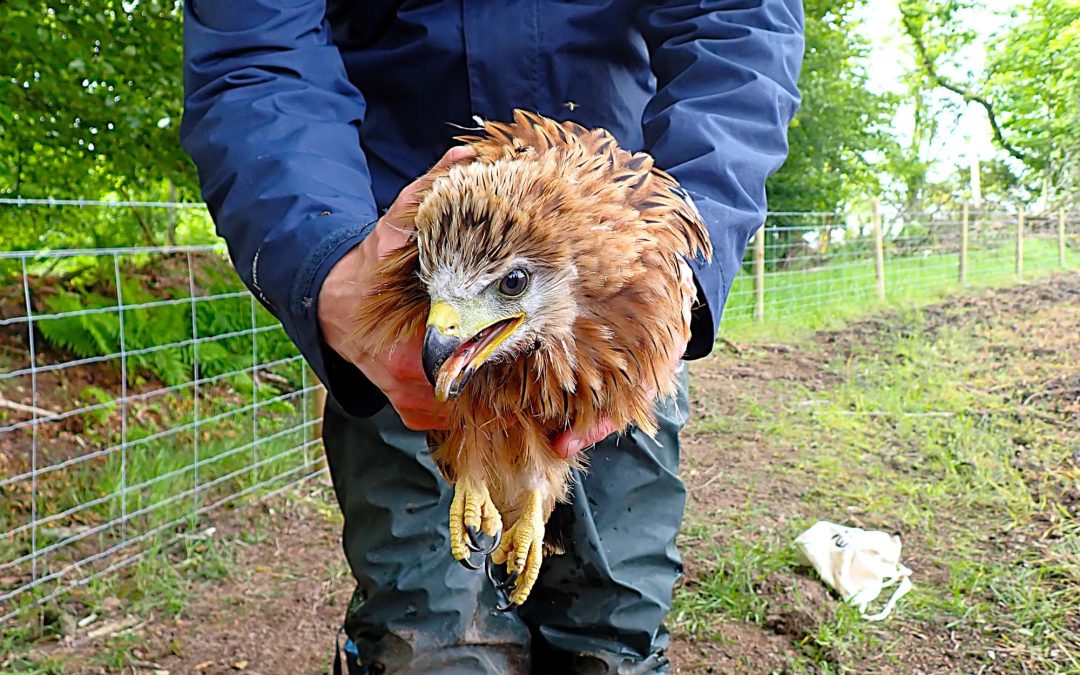
The piercing grey eyes of this young red kite drew me irresistibly into their wild depths, reflecting the rolling fields and woodlands that lie in the shadow of the Braes of Doune.
This was a bird of unparalleled beauty, elegant lines and russet feathers, and remarkably placid too, which is the nature of young red kites when getting ringed. A short while earlier, an expert tree climber had lowered this kite and her sister in a protective bag from its nest to the ground, where they were both carefully leg-ringed and then returned to their nest near the kite viewing centre at Argaty in central Scotland.
Ringing young kites plays a vital part in their conservation, enabling their movements to be studied once they have fledged so that we can learn more about their biology, as well as helping detect any cases of illegal persecution such as poisoning.
The ringing team was led by Duncan Orr-Ewing, Head of Species & Land Management at RSPB Scotland, who has been involved in over-seeing the reintroduction of red kites to Scotland since the early 1990s. In what must rank as one of the greatest conservation success stories of modern times, a bird on the brink of extinction in the UK has bounced back big style due to a series of innovative reintroduction schemes using young birds from continental Europe.
These reintroductions began in 1989 at the Black Isle near Inverness and the Chilterns in England, followed in subsequent years by further releases at several other locations, including central Scotland, Dumfries & Galloway and Aberdeenshire.
At one time, red kites were our commonest bird of prey and their typical gliding flight gave rise to the old name for the bird of glead or gled – derivations of which can still be seen in Scottish place names today such as Gladhouse and Gledhill. However, they were relentlessly persecuted, and in Glen Garry estate alone, 275 red kites were slaughtered as ‘vermin’ between 1837 and 1840. By the end of the 19th century, the gled had been almost completely exterminated from Scotland.
In the early 1900s, there were just five pairs of British kites hanging on for grim survival in the central valleys of Wales – today, thanks to the reintroductions, there are about 6,000 breeding pairs in Britain, representing around 17 per cent of the world population.
Duncan says: “The methods we have developed are now being used as a template model by other European countries instigating their own reintroduction schemes, and this is something we should be proud about it.”
Some of the first young kites reintroduced into the UK came from Spain, and now in an ironic twist, such has been the extent of the British recovery, young birds from England are being used to bolster the Spanish population following a recent decline in numbers in the Iberian peninsula.
The kite, it would seem, is back for good in the British Isles and in the process has become a standard bearer of what can be achieved in nature revival if there is the will and determination to do so.