A passion for nature

Tag: Scottish wildlife Page 2 of 3

A close encounter with a marine leviathan

By Keith Broomfield

A large, mushroom-shaped creature pulsed into view through the briny underwater haze like a mysterious alien from another world. I slowed my breathing through my snorkel tube and watched it glide past, awed by its size and intricate frilled tentacles that trailed behind the bulbous main body.

It was a barrel jellyfish and the first time I had encountered one under water, although I had glimpsed them several times before in Scottish seas from piers and when aboard boats. These cream-coloured monsters really can grow to the size of a barrel, but they are gentle giants, feeding on plankton and their sting is mild and not generally harmful to humans. The biggest specimens can exceed 1.5m in length and 35kg in weight.

I was snorkelling at Ardmair Bay, a sheltered backwater of Loch Broom that lies close to Ullapool in Wester Ross. It is one of my favourite snorkel haunts because of the clarity of the water and the abundance of marine life. As well as the barrel jellyfish, there were scores of lion’s mane jellyfish drifting about, which I carefully steered around because their multitude of long trailing tentacles do give a nasty sting.

I was snorkelling in a sheltered part of the bay, which was home to a host of specialised creatures that prefer a more benign marine environment, including fluted sea squirts, dahlia anemones and burrowing anemones. The white coloured sea squirts were especially abundant, growing in clusters upon seaweeds. Sea squirts have sac-like bodies with two siphons on the top (one inhalant and the other exhalant) through which they draw water and carefully filter out food particles.

A glowing nugget of orange caught my eye on the seabed about 15ft down. I took three deep breaths and dived under to investigate and was rewarded with the remarkable sight of a type of sponge known as a sea orange. It was a fascinating organism – about the size of a cricket ball and with several large pores on the body. Sponges are the simplest of all marine animals, and like the sea squirts, gain nourishment by filtering water through their bodies.

After surfacing and regaining my breath, I drifted over a forest of kelp, and was immediately drawn into the embrace of another bizarre lifeform known as sea mat, which coated fronds of kelp in a dazzling, white crystalline veneer.  While sea mats are superficially similar to the encrusting lichens found on rocks on land, they instead belong to a mystical group of colonial animals known as bryozoans. I lifted gently a frond of kelp to examine the coating of sea mats in more detail, enthralled by their intricate, embroidered shawl patterning.

I ventured back into deeper water and in a truly special moment, a harbour seal swirled past me, before taking a wide circle to inspect this strange humanoid that had encroached upon its watery world. Unsure whether I was friend or foe, the seal flashed away into the blue depths, sparking a tingling wave of exhilaration to course through my body.

Dark green fritillary

Fritillaries and fascinating fungi at Glenshee

The oystercatcher was agitated by my presence, and its piercing ‘kleep, kleep’ call rang around the grounds of Glenshee Parish Church by the Spittal of Glenshee. This bird was a concerned parent with young hidden in among thick grass nearby and was keen to see me off the premises.

The boundary wall of the church made the perfect look-out post  for the oystercatcher to remonstrate against my presence, so I conceded to its will and left the bird in peace, hoping the concealed youngsters will survive the gauntlet of predators and reach adulthood.

Oystercatchers are good parents, and this bird reminded me of an instance several years previously on driving slowly along a small road near Braemar when an oystercatcher suddenly appeared right in front of the car and madly flapped and dragged its wings as if injured. The oystercatcher was not hurt, but had chicks hiding in the grassy verge and was feigning injury to try and draw the intruder – in this case two tonnes of trundling metal – away from it youngsters.

The basic urge of parental protection is a trait found in most adult birds, and as I headed up towards nearby Gleann Taitneach, a diminutive meadow pipit fluttered close above my head as it, too, made its displeasure known at my wandering too close to its nest hidden somewhere nearby.

A heavy rain squall swept across the glen, soaking me through before I had the chance to don waterproofs, but the grey clouds quickly parted and sunshine danced across the landscape once more. The warming rays of the sun brought out a dark green fritillary butterfly, which skipped across the heather and grass in an energetic flight.

Despite the confusing name, they are beautifully patterned orange butterflies, forever on the move and hard to approach close because of their innate wariness. This one spiralled down to the ground and came to rest in among a tangle of grass. I was keen to take a photograph but knew the only possible approach was to carefully crawl along the ground so as not to disturb it.

This presented a dilemma, for the ground was a minefield of cow pats, but throwing caution to the wind, I eased myself gradually along the grass, trying to avoid the dung in the process. The ploy worked and I was able to crawl within a few inches of this tangerine dream to capture it with my camera.

As I lay on the ground, I noticed the cow pats around me were adorned with clusters of glistening toadstools, which I think were a species known as Deconica coprophila. Many types of fungi prosper in dung as it makes an excellent growing medium, rich in nutrients. The fungal spores are eaten by the cows when grazing, which are then excreted, enabling them to germinate and spread. It is a marvellous example of nature at its most ingenious, evolving clever strategies to ensure the optimal conditions for survival and the means to colonise new areas.

An extravaganza of wildflowers in the Trossachs

By Keith Broomfield

A wonderful artistic palette of blue, pink, yellow and white unfolded before my eyes in this corner of the Trossachs where the sun shone down bright and the gentlest of breezes riffled the bee-buzzed air.

As I made my way up the track from Callander to the serene waters of Loch Lubnaig, a cornucopia of different flowers beamed out from the verges, and it was hard to get any regular rhythm into my footfall because every so often I felt compelled to hunker down to examine some new beauty.

Wood cranes-bill was especially prolific, and thick drifts of their blousy violet-blue flowers adorned the track edges in a dreamy haze of colour. The flower of wood cranes-bill is a true show-stopper that features five intricately crafted lilac petals set upon a paler centre where the rich, life-enhancing nectar lies. Subtle radiating lines inscribed upon the petals act likes guides to draw bees and other pollinators in towards the plant’s sweet treasure chest.  

A member of the geranium family, cranes-bill is a wonderfully descriptive name and refers to the elongated seedhead of the plant which for those with an imaginative disposition bears some resemblance to the beak and head of a crane.

Another flower that caught the eye was germander speedwell. Sporting small sky-blue flowers, they were like aquamarine gems scattered in among the thick tangles of grass. This low-sprawling plant is also known as ‘bird’s eye’ or ‘cat’s eye’ due to the white central orb of the flower. I have heard it postulated that the origin of the name ‘speedwell’ may stem from the supposed medicinal properties of the plant. In the eighteenth-century speedwell had acquired to the reputation for being good at curing gout, with the dried leaves being used to make a herbal tea.

More likely, speedwell is so-called because it was considered a good luck charm for travellers with the vibrant blue blooms helping to speed one on your way. In Ireland, they were sometimes sewn into the clothes of travellers for good luck.

Bramble was also in bloom and on some of the tangled clusters, the white flowers appeared larger than normal and belonged to a variety I was unfamiliar with – the five petals spaced further apart and less bunched than usual. The bramble is one of our most diverse plants, there being hundreds of different varieties in Britain with subtle differences, including the taste, size and fruiting time of the berries.

As I pondered brambles, a handsome roe buck materialised in a nearby golden-speckled buttercup meadow. He looked magnificent with his foxy summer coat and two small upright pronged antlers. The roe deer rut begins in mid-July and lasts until the end of August – a time when the testosterone fuelled buck will closely follow a doe for several days, waiting for the opportunity to mate.

Once mating has occurred, egg implantation is delayed until early January and the two fawns are born the following summer, completing the circle of life for another year.

Bewitched by the natural treasures of the sea

After having forsaken snorkelling during winter, a strong hankering engulfed my soul to get back into the water and become immersed once more in the wild riches of the sea.

I had also become consumed with the wish to snorkel by a pier because such places provide shelter for an abundance of marine life. Thus, it was against this background that I found myself bobbing in the chilly waters of the Firth of Clyde by Portencross Pier in North Ayrshire. 

I chose a low spring tide, which would make it easier to dive down and witness creatures that would otherwise be hard to reach in deeper water. The visibility was reasonable and on flicking my flippers I soon reached the first of the steel piles that supported the T-shaped pier end.

Mussels and barnacles clung tenaciously to the upper parts of the stanchions. They are resilient creatures, enabling to withstand the rigours of storms, fierce currents and crashing waves without becoming dislodged from their holdfasts. Barnacles could easily be mistaken for molluscs, but curiously they are crustaceans and relatives of crab and lobsters.

While the barnacles and mussels on the upper pier supports were fascinating, my main interest lay in the deeper water below, and as my body rode the undulating waves, I peered down into the murky green depths. Just within the range of visibility, an orange glimmer shone out. I dived down and steadied myself by holding onto the pier support. Before me lay the most exquisite creation, a cluster of orange-tinged fleshy lobes. Surrounding each lobe was a soft, opaque furred fuzz that on closer inspection comprised of miniscule stalks tipped with white.

This was a soft coral known as dead-man’s fingers, so called because it is said to resemble the swollen, decomposing hand of a dead person. Each ‘finger’ consists of a colony of tiny organisms, called polyps, set upon a shared gelatinous skeleton to form a greater whole. Each polyp has a mouth surrounded by tiny tentacles, which trap tiny food items in the water column. I imagine the name ‘dead-man’s fingers’ arose from times past when people searching for survivors from shipwrecks became overwhelmed by the stress of the occasion, sending their minds spinning into overdrive and suspecting the worse.

Then, I snorkelled under the pier where on several of the supports lay a bewitching cornucopia of colour comprising large colonies of plumose anemones. Their beauty and form were breath-taking, elegant orange-brown anemones featuring long, slender tubular body columns with flickering tentacles that brimmed out over their tops like large, intricately frilled umbrellas. As a biological comparison, these anemones were single polyps, while those that form dead-man’s fingers are integrated polyp colonies that act like one organism.

I snorkelled for a while longer, but the wind was picking up and the sea rising, so I swam back to the shore. On pulling myself out onto a flat rock shelf, I barely noticed the cold such was my excitement at having glimpsed these wondrous marine creatures.

Revealing the secret life of a Scottish river

Using a pair of trail cameras, I have been monitoring a shallow offshoot creek of my local river where a diverse array of wildlife was captured on film.

Teal were the principal stars that appeared daily. They adore this little creek because the calm, shallow confines act like an oasis where they can feed safely on the rich muddy bottom by up-ending continuously. Teal are delightful little ducks that are active both by day and night. A small group of female goldeneye ducks also appeared on the camera one day. They are scarce winter visitors to this river, but when the weather gets cold and nearby lochs freeze over, a few always materialise to take advantage of the fast-flowing and ice-free water.

Herons regularly showed up, stalking in the shallow margins with slow and cautious movements as they carefully scrutinised the water for fish.

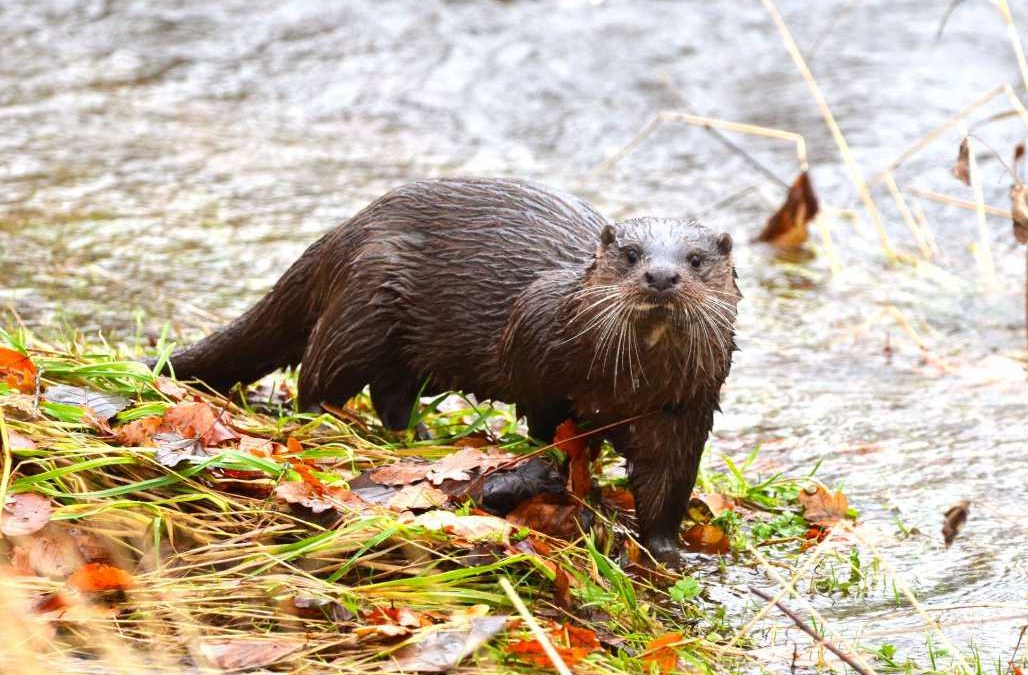
An otter briefly materialised on one of the videos, quickly skirting the edge of a pool, its back undulating in a sinuous and weasel-like movement. Otters are doing well on the river but are seldom seen because of their mainly nocturnal and secretive habits.  However, when walking river banksides, it is easy to see their scent marking sites where they have deposited their tarry-like spraints (droppings) on top of prominent locations such as rocks, tree stumps or small hummocks.

A water rail – one of our most elusive water birds – made a cameo appearance. Like the otter, water rails are commoner than one might imagine and lurk in reed-beds or among thick tangles of waterside vegetation making them very difficult to spot.

I was also thrilled to have secured several clips of snipe feeding in the shallows. The snipe, which is a small and long-billed wading bird, is a master of concealment and it was wonderful to get a glimpse into their secretive lives. In one instance, the camera filmed a pair where one bird tried to mount the other as if mating. It is far too early in the season for mating to occur, but the clip did reveal that spring is maybe not as far away as one might imagine.

The most fascinating piece of film, however, was a snipe catching a brook lamprey. At this time of year, slowly maturing brook lampreys live under the sediment of rivers and have the size and appearance of small eel, only about 10 cm to 14 cm long. This feeding snipe hit the jackpot and pulled the wriggling lamprey out from its muddy lair with its long and probing bill. The snipe wrestled with the lamprey for several seconds before swallowing it with a satisfied gulp.

I knew brook lampreys lived in this pool and had previously glimpsed them emerging as adults in early spring after having spent a few years under the mud as filter-feeding larvae. Brook lampreys are fascinating fish that encapsulate the very beating heart of our rivers – mysterious and alluring, and with a never-ending capacity to surprise.

New life arises from storm damage

Whilst it has been an unusually mild winter, it was also an extremely windy one, and the full impact of the havoc wreaked by a succession of storms was brought home to me the other week when driving through the Howe o’ the Mearns.

It was in the aftermath of Storm Corrie, which itself had been preceded by Storms Malik and Arwen, and as I drove from Cairn o’ Mount, past Fettercairn and down towards Luthermuir, there were tumbled trees everywhere, some of them mighty oaks and beeches. Huge branches had been torn asunder and trunks split, leaving gaping wounds and cavernous cracks, while woody debris lay scattered across fields and hedgerows like tidal flotsam.

On passing the forestry plantation at Inglismaldie woods, the damage was particularly severe. It was both shocking and humbling, a stark reminder of the power of nature.

Colin Gibson, The Courier’s renowned nature diarist, recounted the turmoil caused by a storm in January 1953. He wrote: “The north wind came down like a wolf on the fold, and was at its most ferocious at noon, raging through Tayside and the whole north-east of Scotland.

“In Perth it ‘yowled up frae the vennel’d toun’, in Dundee it roared over Balgay and the Law, and hurtled debris from the rooftops into the city streets.”

For commercial foresters the damage cause by such storms is devastating, but for nature it is often a different story, for storm-felled trees bring new opportunity.

Wild storms have been felling trees since the dawn of time and it is all part of the natural cycle of regeneration. The clearings created deliver dappled sunlight to the woodland floor that encourages wildflowers, which in turn attracts butterflies and numerous other invertebrates that themselves are preyed-upon by shrews, insect-eating birds, and bats. The fallen seeds of trees can now germinate and grow in these sunny open places, completing the continuous circle of natural regeneration and delivering new vitality to the woodland.

Inside a decaying tree trunk there is a wonderful diversity of life. Peel apart the soft and crumbling bark, and a myriad of tunnels are revealed, which have been created by thriving populations of specialised invertebrates.  On the surface of the trunk are intricate tiny cup-shaped lichens, fungi and many mosses, along with the bullet-mark indentations caused by foraging woodpeckers.

It is not all positive, and severe storms in early spring and summer cause immense problems to tree-nesting birds, such as ospreys. And, of course, there are wildlife communities that depend upon living trees, such as caterpillars and the songbirds that feed upon them. However, seldom is a whole woodland felled by a storm, and it is this mosaic of tumbled and living trees, which creates such wonderful diversity.

Near my home lies a long-tumbled, wood-rotted oak, which in autumn becomes adorned with colourful fungi, including lemon disco and velvet shank. Exploring every nook and cranny is a special experience, for the death of this oak has created a plethora of new life that is a sheer joy to behold.


TheTay reveals its natural riches

I adore rivers – serene slivers of tranquillity that wind their way across the landscape, and which are always brimming with natural wonders. And when it comes to magnificent rivers, the Tay is right there at the top, with a majesty and power that excites me on each visit.

I hadn’t explored the stretch between Stanley and Dunkeld before, thus it was with great anticipation that a couple of weeks ago I struck upriver from Stanley Mills. This former textile mill is a reminder of the power of our rivers and how they helped drive the industrial revolution. It also highlights how humanity has long depended upon rivers, whether for drinking water or energy, or as providers of fish as food, or as is the case in some parts of the world, as conduits for transport. The fact that we depend upon rivers means we are more likely to look after them – a concept I find appealing.

Rivers are also places for relaxation and as I made my way up the west bank, a group of canoeists whizzed past on fast-beating paddles. My eyes were soon drawn back to the riverbank, where at the foot of a hazel tree, a cluster of snowdrops glowed like early heralds to the approach of spring. Not to be outdone, the hazel was adorned with dangly lime-green catkins, which are so appropriately known as lambs’ tails.

Out on the river, a dipper swam on the surface like a little duck, twirling around and frequently diving under in its quest for invertebrates and tiny fish. Dippers are songbirds that have embarked upon a remarkable evolutionary twist, which enables them to forage underwater. It is an adaptation that underlines the genius of Mother Nature. In deepest winter when the ground is frosted hard, songbirds such as blackbirds and thrushes struggle to find worms and other invertebrates. Such cold periods are a breeze for dippers because fast-flowing rivers never ice-over, providing round-the-clock access to rich feeding areas.

And believe me, riverbeds abound with life. Only the week before, I was invertebrate sampling on my home river, the Devon, as part of an initiative to monitor the health of our waterways. On emptying the sweep net into an examination tray, a plethora of invertebrate larvae, or nymphs as they are known, materialised. They are the ‘engine room’ of the river, the powerhouse that supports so much other life such as trout and ultimately top predators like herons and otters.

Further on up the Tay, a beaver-gnawed willow stump shone out at me. The small willow had tumbled into the river, enabling the beaver to feed on its twigs and bark from the safety of the water. The willow had been coppiced and will regrow, while the trunk and branches lying in the river will provide shelter for invertebrates and fish, just as how a rocky reef might do at sea. By felling this willow, beavers had created a new habitat for river creatures to thrive and prosper.

Shellfish Firth of Forth

The fabulous marine riches of the Firth of Forth

By Keith Broomfield

There was a perceptible crackling noise as the pressure of my footfall crunched into storm-scattered seashells on the strandline at Largo Bay in the East Neuk. This was a graveyard of marine life – cockles, surf clams and razor shells, scoured from their homes beneath the sand by the tumultuous power of the ocean.

I wondered whether these shellfish were victims of Storm Arwen, which had hit the east coast at the end of November. I hunkered down and scooped-up a handful of these half-shells, and then let them gently slip through my fingers. Each shell was intricately crafted, the elongated razor shells still gleaming with iridescence, and the surf clams exhibiting intricate concentric patterning.

This abundance of molluscs underlined the vast reservoir of marine life held within the sediment of the Firth of Forth. Although inshore mud and sand can appear barren at first glance, it is often hugely productive and an environmental powerhouse that supports so much else.

Coastal sand and mud habitats may lack the diversity of species found on rocky shores, but this is more than compensated by the sheer abundance of those that live within this hidden, secret environment. These sand creatures, such as cockles, abound in one of the toughest places imaginable, continually pounded by wild storms and surging tidal currents. They are true survivors and a testimony to the endurance of nature.

As well as the razor shells, surf clams and prickly cockles, there were also the empty shells of whelks, limpets, otter shells and queen scallops on the strandline. It was a wonderful cornucopia of the sea’s riches.

I wandered further along the beach, inadvertently putting to flight a mixed flock of ringed plovers and dunlins. Out on the sea, eider and scoter ducks bobbed in the undulating surf, frequently diving in search of crabs, mussels and other food.

I scanned the water further offshore with my binoculars, hopeful I might spot the humpback whale that has been residing in the Forth in recent weeks. A fortnight previously, I was thrilled to spot this humpback from a vantage point by Kinghorn as it cruised offshore in the shadow of Inchkeith island.

It was a truly magnificent creature, and although some distance away, I could clearly discern the spouting sprays of water being emitted from its blowhole after exhaling from each dive. The humpback population is slowly recovering in the north-east Atlantic following the decimation wreaked by whaling. In recent years, individuals have been regularly turning up in the Forth for short periods.

The presence of this whale was an encouraging sign because humpbacks feed on sprats, sand eels and small herring, and its prolonged presence in the Forth presumably meant it was finding an abundance of these nutritious fish.  The Forth is an important nursery ground for young herring, which along with sprats, thrive within the estuary’s protective embrace.  Hopefully, in the years to come, humpbacks will become an even more regular sight in the Forth, acting like leviathan flag bearers of the crucial need to protect our precious seas.


The plight of Scotland’s guillemots

Something didn’t seem right, and I couldn’t quite put my finger on it. I was on an early morning visit to Peterhead harbour and the inner basin was full of guillemots, their black and white forms bobbing out on the water.

I had never seen so many guillemots in the harbour before and their occurrence in such numbers seemed strange, especially since there had been no recent storms, which might have been one reason for these auks to seek shelter within the protective embrace of the port.

Then, I noticed something even more worrying – the bodies of several dead guillemots floating in the water. What on earth was going on? I wasn’t sure, but perhaps these birds were starving and had sought the harbour as a calm place where to seek out fish. Two days later, I was down on the foreshore at Elie in Fife, where I found more dead guillemots on the strandline – these engaging little seabirds were experiencing calamitous turmoil that was causing mass mortality.

This is a phenomenon that has been noted up and down the North Sea coast this autumn, with hundreds of dead guillemots having been recorded. The issue is currently being investigated by the UK Centre for Ecology and Hydrology (CEH), who have found the birds to be emaciated. The guillemots are certainly behaving strangely, and some birds have even been spotted up rivers, which is most unusual.

CEH has ruled out bird flu but is investigating other possible causes, which include a lack of suitable fish in the sea for the guillemots to feed upon or poisoning by toxins from marine algal blooms, which is affecting their behaviour.

Whatever the cause, the phenomenon does illustrate the fragility of our marine ecosystem and the dangers presented by pollution and climate change. In my new book, A Scottish Wildlife Odyssey, which will be published by Tippermuir Books later this year, I highlight the plight of Shetland’s kittiwakes, which are experiencing tumultuous population decline.

I write: “The underlying problem is related to our warming seas, which has led to planktonic ecosystem shifts resulting in a decline in the abundance and size of sandeels. Kittiwakes are especially vulnerable to food shortages as they can only take prey such as sandeels, sprats and juvenile herring when they occur at or near the surface of the sea, unlike deeper diving species such as gannets.”

A few years ago, I attended a science conference in Aberdeen, which explored the marine impacts caused by climate change. The evidence from the speakers, all of them experts in their field, was compelling; our warming seas are having a real and discernible impact on the distribution of many marine species. With the COP26 conference to discuss global action on climate change due to convene in Glasgow soon, it is more imperative than ever that it delivers a strategic plan for addressing this ticking timebomb that is already beginning to wreak havoc upon our precious marine life.

Scotland’s amazing cetaceans

By Keith Broomfield

I adore travelling on ferries between the Scottish mainland and the Hebrides, and on embarking upon a CalMac ferry for a recent voyage from Uig in Skye to Tarbert in Harris, I immediately hurried to an outside viewing deck – for I knew I was in store for a spectacular wildlife treat.

I was especially excited because the sea was unusually calm, a flat reflective mirror, which dramatically increased the chances of detecting whales, porpoises, and dolphins. The Minch abounds with these marvellous animals, but when the sea is wave-crested, their rolling backs and fins are hard to discern.

My anticipation soon bore fruit, and before the ferry had even passed Waternish Point in Skye, several porpoises had materialised, their shallow arch-backed rolls only gently breaking the water’s surface. Porpoises are the commonest whale and dolphin species (collectively known as cetaceans) found off our shores, as well as the smallest, being less than two metres long.

Although reasonably common, it is thought that porpoise numbers are in decline, a sad testimony to the many threats facing our precious marine environment, including pollution and climate change. Porpoises are not as sociable as many other cetaceans, tending to hang around in small loose groups, individually, or in mother and calf pairs, hunting for shoaling fish such as sandeels, sprats and herring.  

Porpoises are undeniably attractive creatures, and I recall once finding a dead porpoise on Balmedie beach, north of Aberdeen, and being blown away by the sleek beauty of the creature. The skin was like polished ebony, the rounded face benign and attractive. It was a silken torpedo, perfectly designed for its oceanic life in search of fish. 

As the ferry – the MV Hebrides – left the Skye shore in its wake and began its traverse of the Minch, a much larger rolling back suddenly broke the water off the port bow – a minke whale. As quick as it had surfaced, the animal disappeared. ‘Please reappear’, I intoned silently.  Thankfully, it did so once more, this time astern of the vessel. Minkes are smaller in length than most other whales.

Minkes are the most frequently encountered whale off the Scottish west coast, and on calm days can even be spotted from the shore – rocky headlands offering the best vantage points.

My return journey a week later was on the Stornoway to Ullapool ferry. The sea was rougher and for most of the way I was unable to spot any cetaceans due to the conditions. Then, as the vessel approached the Summer Isles at the mouth of Loch Broom, the water quickly calmed.

The signs were looking good – and so it proved, for a short while later, the ferry swept past a large pod of common dolphins, their pale flanks catching the sunshine each time they breached the water, sending my mind spinning with enthralled excitement.  Whales and dolphins are an oft-forgotten part of Scottish nature and I felt truly privileged to have had a glimpse into their secret lives.

Page 2 of 3

Powered by WordPress & Theme by Anders Norén